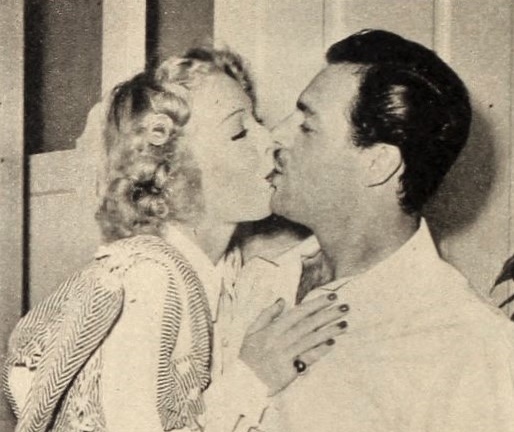
Betty Hutton kisses her first husband, Ted Briskin, 1949.
Public domain image cropped from original photo via Wikimedia Commons.
He’s a Demon. He’s a Devil. He’s a Doll
Written by Don Raye and Harold Spina | Performed by Betty Hutton
In 1950, American actress and singer Better Hutton performed He’s a Demon. He’s a Devil. He’s a Doll. Even 75 years later, the song has not lost its relevance or quirky punch. The lyrics show an exasperated woman trying to convince herself to leave a man that she—and the rest of the world—knows is no good for her. She may not succeed, however, as the song demonstrates; impaired communications, her distorted perceptions, and insecure attachment are all stacked against her.
The character presented in this song is in love with the idea of a prototypical romantic partner. Prototypes represent an idealized example of a particular type of person, and this “doll,” this “darling,” is exactly that: he is handsome and charming. Her lover is “sweet.” He is “true.” Hutton’s frustrated lady is smitten and can’t quite see past this hyper-idealized version of the man to the reality that she is instead involved with a stereotypical philanderer with “lipstick on his tie.” Here we see the predictive, over-generalized idea of such a man; he lies, he cheats, he drinks, and he breaks his promises. Worse, he manipulates her, “That man can look me in the eye and tell the biggest, sweetest lies.” But never mind all that; he can still thrill her “through and through.”
Interpersonal Communications by Julia T. Wood defines interpersonal communication as a “selective, systemic process that allows people to reflect and build personal knowledge and create shared meaning.” The lyrics insinuate that our damsel and the eponymous devil are engaged in an on-and-off-again conversation, and while that communication is certainly happening within the system or traditional framework of a romantic relationship, it’s clear from the song that their communication fails to meet the complete definition of interpersonal communication. He may promise to “call for [her] late at night,” they may make plans to go “out somewhere to dine,” and he can sing “Sweet Adeline” to her, but nothing shows their communication going deeper than the superficial. She can’t hope for greater breadth of personal knowledge or deeper shared meaning with this scoundrel, because making plans and drunken serenades do not equal intimacy. No shared meaning is apparent here, only consternation.
Intrapersonal communication refers to the internal dialogue we have with ourselves. We see some evidence of the woman’s own inner dialogue embedded in the song’s message. “Sometimes I make up my mind, That I’ll stop being so blind,” she complains bitterly, indicating that she has inwardly wrestled with this quandary more than once. Likewise, her words occasionally shift into metacommunication, which is when we speak about how we are communicating. She attempts to motivate herself and plans how she will talk to this cad. She will “tell him off real bad” and “ought to tell him, ‘drop dead!’” If only she could.
This bewildered lady eagerly endorses how wonderful he is and yet at the same time declares, “he’s a palooka.” She is clear: “he’s a dog!” This wild swinging back-and-forth shows the full scope of her bipolar personal construct for a romantic partner. Constructs are the mental yardsticks we use to judge others and their behaviors: kind or unkind, faithful or faithless. Or in her words, he is both “cute” and a “brute.” When they are together, however, she only utilizes the positive, attractive side of the constructs, those that allow her to judge her man as “true” and a “dreamboat.” In these moments, she has no access to the more accurate side of the constructs, the ones that would make his brutishness, his lying, and his infidelity clear and undeniable to her.
Due to her constructivist scripts around navigating intimacy and betrayal, there are moments in the song when she seems close to following her own advice. Constructivist scripts are relational guides we use to manage our behavior in certain situations and with certain people. She knows that when someone treats you poorly, you should end relations with them, “I ought to tell him to ‘drop dead!’” This is reinforced by what her community is telling her, “Everyone tells me he is no good, He doesn’t love me like he should.” And yet, she scolds herself with lines that let us know she is as frustrated with her own behavior as with his: “I keep loving him instead” and “I would forget him if I only could.”
Unfortunately for this poor woman, there are two types of noise within her experience and communication that prevent her from honoring those constructivist scripts and ending the relationship. Noise consists of any physical, physiological, psychological, or semantic interference in communication that distorts clarity or meaning. It’s clear that her self-talk and plans for action are affected by physiological noise stemming from her physical attraction to this man, “But then he turns on those charms, And there I am in his arms, And I forgot why I’m mad.” She literally can’t think straight when he is around!
There is also evidence of psychological noise in the form of her attachment style. Attachment theory suggests that the patterns we experience with our early caregivers implicitly guide us in how we navigate adult relationships. She recognizes that he’s not available, meeting her needs, or even treating her fairly, but a classic presentation of anxious/ambivalent attachment fuels her confusion and erratic behavior. An anxious/ambivalent attachment style results from inconsistent early caregiving and is characterized in adulthood by a preoccupation with relationships, issues with self-esteem and self-worth, and often leads to inconsistent behavior in relationships. Like her early attachment figures and her current lover, she too is inconstant. She wants distance, “I wish he were in Timbuktu,” and she clings, “But I keep loving him instead.” The pattern repeats: He is as bad as “poison ivy and clumps.” He “drives [her] crazy.” But, oh lord, he is a “dreamboat,” and she lands once again, “right there in his arms.”
Over and over, this gal’s disregard of traditional constructivist scripts telling her to leave him, and her warped identity scripts—those formed by her attachment—compel her to hold on to him. Unlike constructivist scripts, which are guides to action in familiar situations, identity scripts inform us of who we are and how we expect others to treat us. If she truly understood she deserved better, she would heed what “everyone” accepts: “he’s no good” and “does not love [her] like he should.” It’s here in these words—“like he should”—that she acknowledges that he should treat her better: show up, be honest, and not cheat. And yet, her attachment-influenced identity scripts include a compromised idea of her own self-worth. Instead of leaving him, she will keep being “blind” and allow him to “drive [her] crazy.” She even jokingly attempts to make light of her poor decision-making, “My momma must have dropped me on my head.” If she genuinely believed she deserved more, she would have already ended it.
Our vexed lady readily admits he is a “dog,” yet despite consciously knowing what’s in her own best interest, she can only engage in unconscious behavior that suggests she is locked in a self-fulfilling prophecy driven by anxious/ambivalent attachment. A self-fulfilling prophecy occurs when we internalize expectations and assumptions about ourselves and then behave in ways that make those expectations come true. In our lady’s case, she yearns for the gumption to leave him. She knows she should, after all. Then he woos her once again. She loses focus, forgives him, and she accepts his abysmal treatment, which only serves to reinforce her low self-worth. She sings:
Sometimes I make up my mind
That I’ll stop being so blind
And tell him off real bad
But then he turns on those charms
And there I am in his arms
And I forget why I’m mad
Then she laments, “Why do I love a guy I ought to shoot?” Because, in her mind, if she were to insist on better treatment and/or leave him, she would find herself alone and unloved, and this would confirm her sense of worthiness.
In the end, she can’t end it or even demand more from this devil because, in spite of everything, her communication remains compromised. Likewise, she can’t disengage from the personal constructs that create her contradictory, one-sided concept of this man, or from the identity scripts that inform her sense of her own value. And, of course, as long as her deep-seated anxious/ambivalent attachment is running the show, she may not even think she wants to.
It’s much the same today as it was in the 1950s; dreamboats and dogs will do that to a gal.
Leave a Reply