Considering self-soothing, attachment, and transformation.
Part 1 : Bears.
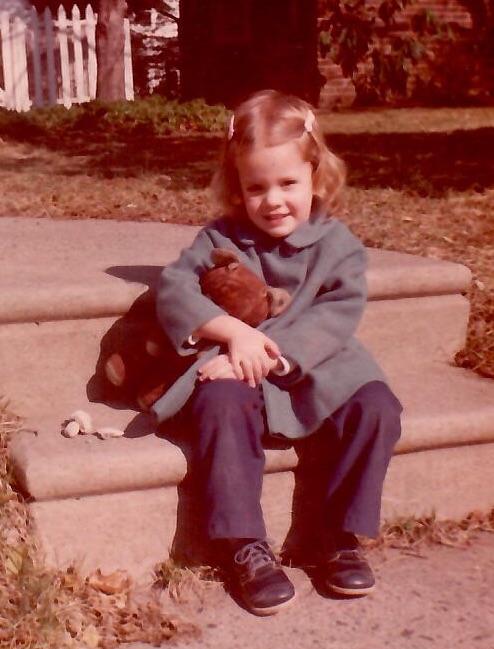
Can I tell you a story? It’s about a very young, very shy little girl who felt alone, unloved, and often unsafe. A little girl who, rather than seeking reassurance from her family, learned to tolerate those troubled feelings by sucking her thumb and desperately clutching her teddy bear. She felt more warmth and security through an oral fixation and an object than with her caregivers.
Okay, screw the pretense. It was me. That sad, scared, lonely little girl was me. And the faithful bear was named Teddy. Teddy was so thoroughly adored that he was constantly on the verge of coming apart at the seams. His once-thick fur was rubbed nearly completely off, and what remained was short and velveteen to the touch. I took him everywhere my parents allowed and, in quiet moments of much-needed soothing, rubbed his cool, worn fur against my own cheek.
At some point, my grandmother, hoping to stem the tide of loose stitches and lost stuffing, sewed him a stiff, prim polyester suit. The fabric she chose was brown, with a strange repeating pattern in white. She topped it off with three red buttons upon his chest. This suit was a permanent addition, sewn directly into his sagging little body.
This was highly functional and would have been delightful to my young mind, except that the fabric she selected for the job was rough and scratchy. I could not stand the feel of his new body on my skin. The only part of him left with his original, worn fur was his head and ears, and so my stimming took on a new, weirdly intimate quality; I rubbed his cheek on mine over and over and over.
I sucked my thumb and carried Teddy until my mother decided it was no longer age-appropriate. She brute-forced the thumb-sucking with admonishments, rebuke, and heavy coats of terrible-tasting nail lacquer. Soon enough, I begrudgingly gave up my thumb, but the bear remained. After a time, my mother turned her efforts toward curtailing that habit as well.
After a time, my mother undertook efforts to curtail that habit too. If my father had a hand in any of this, for better or worse, I have no memory of it. In the end, the issue with Teddy was resolved with a less direct approach—one that involved explicit and shaming messaging about how only babies required bears. My mother did not take Teddy away from me, but she convinced me that I should be ashamed for needing him. I threw him away of my own accord. I can barely believe I did it.
When I think now about disposing of my beloved bear, it still guts me. My heart aches in the same way it might over a dead pet or lost treasure—something beyond precious, gone with no hope of recovery.
At the time, for a few bright moments, I felt proud of myself. I proved, by this terrible act, that I was growing up! My parents would be so proud of me, too, right? Maybe—but what did that matter? Any pride I felt was quickly replaced with panic. How could I sleep alone without Teddy? How would I feel safe, alone in bed, in the god-awful dark?
For a young, worried Mars, there was only one solution. I quickly attached myself to another bear, one that had been on hand but previously unimportant. I was careful not to clue my mother into his adoption. I never even properly named him; I only ever called him “Bear.” Thankfully, he served as a suitable stand-in, and over time, I grew as devoted to him as I had been to Teddy. In the early years, Bear stayed securely in my bedroom. Had I insisted on taking him places with me, it would have clued my parents into the intensity of my reliance on him. That I have no memory of being discouraged or scorned for Bear was likely a testament to how carefully I guarded his importance.
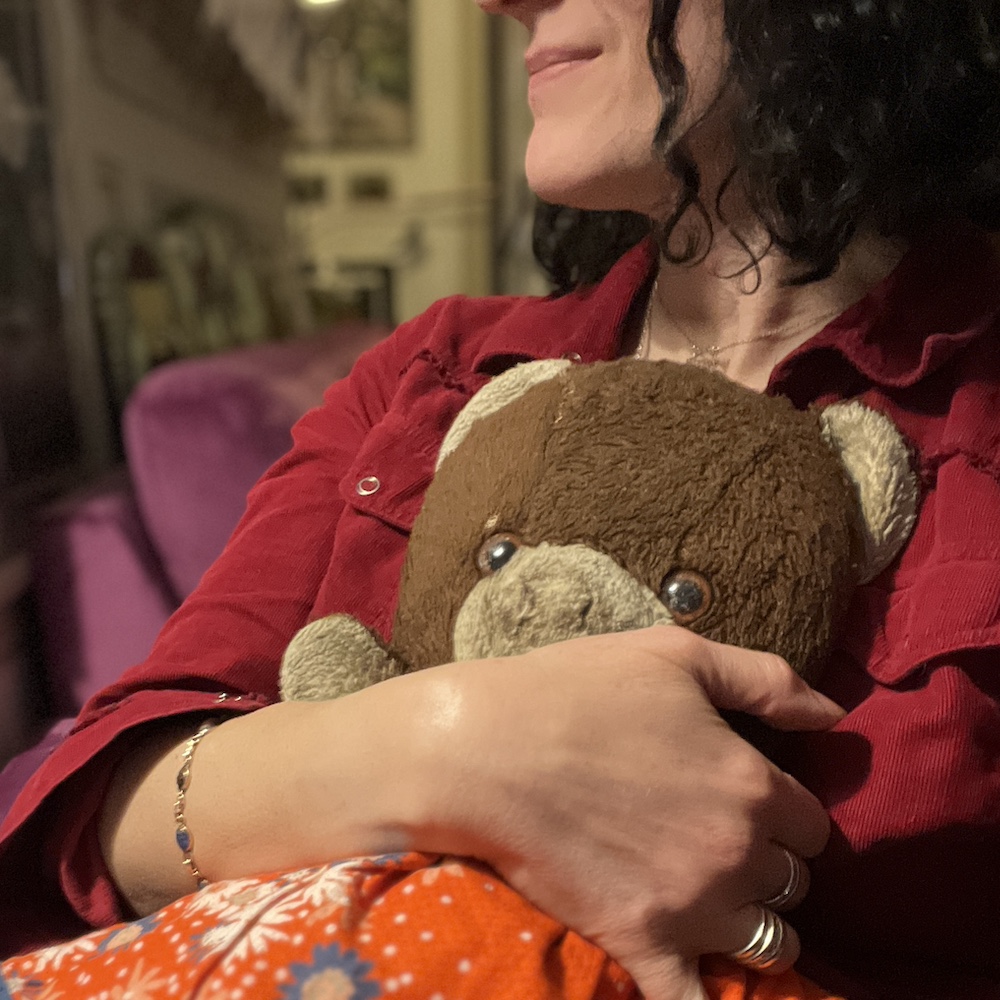
I slept with this stuffed animal every night until I was in my 30s. I shit you not. As an adult—when I could no longer be scolded by my parents, at least—I discreetly took him on overnights and vacations; Bear has been to half a dozen states and Europe three times. He was finally retired—relegated to a box in my closet—when my first and only live-in boyfriend moved in. Even so, Bear moved with me three times after that and still resides with me, now tucked gently into a drawer.
Over the years, Bear suffered from my devotion as much as Teddy did. He lost his luster, the brown felt of his nose, and a good portion of his stuffing. He lost his luster, the brown felt of his nose, as well as a good portion of his stuffing. His plastic eyes grew cloudy with scratches, like some form of stuffed-animal glaucoma. He looks much worse for wear. Even now, snoozing away in that drawer, he is still primarily held together by safety pins and, randomly, one kilt pin.
The advent of adult partnering eliminated my need for a comfort creature. Or so I assumed. I can’t be certain whether that was because I shared my bed with another human being or because that human and I drank copious amounts of alcohol together. Probably some combination of both. What I can tell you with certainty is that I have felt disconcerted and restless for a very long time. As a young adult, I drank myself to sleep most nights because, well, young adulthood—and because I was wholeheartedly self-medicating a host of woes I nursed all day long. I know my partner was a support in his way, but I also know that our shared drinking functioned as a medicine for coping with a lifetime of unexamined trauma and undiagnosed neurodivergence.
In any event, this bear-ostracizing affair ended with a toddler nursing in my bed. This changed everything. The bond I formed with my child was profound. I fell in absolute love with the warm, squirming, hot-water-bottle solace of nursing and bedsharing my babe. Even at the time, its significance stood out to me; it was healthy, healing, heartening. I understand that not all mothers get to experience this, or that, if they do, it might not register the way it did for me. I also suspect it may not stand out with such astonishing radiance to those for whom a safe connection is second nature.
Even as it was happening, I was awed by the sense that what I embodied with my child was the only genuinely secure and corrective physical relationship I have ever had. It was tremendously impactful. It opened me up to something I never believed possible: attunement, co-regulation, joy, and safety in physicality. It was the real deal.
Even after the kiddo weaned, we shared a bed. They were with me for a decade. At 10, they moved into their own room. The heartache that came with this transition was, if I’m being honest, accompanied by a solid sense of relief; I started sleeping through the night for the first time since their birth. On the other hand, the process of falling asleep became much murkier and more difficult. Instead of slipping into sleep next to the snuggly heating pad that was my child, I started to scroll on social media until I passed out. Facebook and Instagram became a poor replacement lullaby. Looking back, I can acknowledge that on most evenings the scrolling shifted from self-soothing to full-on sedation.
And I hated the way I felt hijacked by those fucking apps—and worse, with my phone always within arm’s reach, I would pick it all back up again in the morning. To say it felt as if the algorithms had eaten my brain was an understatement, so after about a year of this unchecked, unsavory, and infuriating behavior, I made the bold move of removing the social media apps from my phone. I was prepared for a sea change of sound sleep after an easy, early bedtime. I was ready for my sleep, my attention—hell, my whole world—to get infinitely better! Go me!
But that’s not what I got. To be fair, I did gain oodles of attention, focus, and blessed time once the social media apps were off my phone. It’s done me a world of good, and I hope I never return to the zombified version of myself from before I ditched the apps. But any benefit I saw seemed to grace me only during daylight hours. In the evenings, something else emerged. A bizarre floodgate of dysregulation opened.
As soon as dinner was over each evening, I grew restless and tense. To avoid how agitated I was, I began engaging in endless novel chores, projects, and tasks. I became a dopamine-seeking, high-functioning housewife. And then, as each evening wore on, I would eventually shift from this hyperarousal to craving ways to feed my opioid-starved brain: I drank wine, ate snacks, and shopped online. I began staying up later and later. It was nearly impossible for me to get through an evening without trying to “relax” through compulsive overdoing or overconsumption. And forcing myself into bed each night felt nothing short of Herculean.
When I made the seemingly mature, balance-seeking decision to step away from social media apps, I had no idea it would bring more turmoil into my life. But there was no denying it: my distress didn’t disappear; it simply shifted sideways and found new ways to seep out of me.
At first, I had difficulty seeing it clearly. I tried to strong-arm myself out of these seeking and soothing behaviors with willpower. Ah, willpower—when will we ever learn? There have been some changes in my life that sheer will has brought about, but not many. The discipline it takes to add a habit to my life has benefited from willpower, assuredly. Still, I have rarely—if ever—found that breaking a challenging habit is helped along by will and determination alone. It’s a hard, relentless work.
And in this case, I couldn’t convince myself to stop self-soothing because, for one thing, I didn’t see what it really was at first. I thought it was boredom. And so I planned to fill my time with low-key movies, cozy books, and good friends on call for conversation—anything to set up an early, non-consuming bedtime. None of it helped. In fact, I often grew truculent and refused to engage in the relaxing activities I had set out for myself. Instead, I was emptying closets, climbing ladders, hanging art, or, God knows, whatever. I huffed and puffed in self-pity and refused to call the pals I had lined up for help. What I could not see was that this was not about boredom. It was about nervous system regulation. And not to put too fine a point on it, willpower doesn’t do much to calm one’s twanging vagus nerve.
When I couldn’t stop and failed to see what was really happening, I defaulted straight into shaming myself for not being able to say no to the consumption. I fussed and stewed, convinced it was all driven by addictive propensities and suspect morals. Seriously, I saw myself as weak and compromised.
This is awful in a my-own-worst-critic way, but also in a neurobiological sense because I know where addiction comes from (trauma), and if I had given myself even half a moment more perspective, I might have seen that it was all standing in for the comfort that I was trained and scolded out of as a child. And God, no wonder I shamed myself in these moments. That’s precisely what my parents did.
And never mind that resolving the “why” of it with “the self-soothing that I was trained and scolded out of as a child” is yet another in a long line of ridiculous and shortsighted simplifications. The shame was secondary. What I was really suffering from was the lack of attachment and safety in the first place.
In time, it dawned on me that I was attempting to mollify a very deep hurt. It still felt a smidge nebulous, so I shifted into reparenting mode. I tried to go easy on myself, finally realizing that all I had been doing was the self-talk equivalent of telling your kid not to have feelings because you feel triggered or inconvenienced by them. I didn’t like how I was acting out in the evenings, so I tried to shut it down with unfeeling and uninformed demands. Jesus, if I have learned anything as a parent—and as a human in general—it’s that you can’t talk a person of any age out of having feelings “because I said so.”
I started pausing in my chagrin and criticism just long enough to meet it all with compassion and curiosity. I reparented the shit out of myself. I really did. I spent evening after evening, my hand on my heart, breath after breath, trying to engage my inner children in conversation. It did no good. Not a single reply came. It was baffling. And deeply frustrating.
For better or worse, inner child and parts (IFS) work comes very easily to me. It makes simple, intuitive sense to me to allow different versions of myself to speak and feel separately from one another. Working with this conceit has brought me enormous emotional and therapeutic insights, but I was starting to suspect I had lost my knack for it—because I was having zero success with this stubborn part of me.
Whoever’s running the show each night after sundown is firmly, unrelentingly mum’s the word. Rather than responding to me in thoughts or even feelings, some nonverbal autopilot—someone who hungerily craves comfort, come what may—takes over. I experience me, myself—in real time and with stunning clarity—willfully ignoring my own adult prohibitions, wishes, rationalizations, pleas, and demands, and then, like some alert but ensorcelled sleepwalker, I get up, fill my cup, grab the chips, and click “buy now.”
As I typed these words, I realized that nonverbal might not be an accurate descriptor. What if it’s more preverbal? What if the child driving all of this was younger than I imagined? That might make sense. And so, next, I decided to stop struggling and give myself whatever I wanted to eat, drink, and buy. Fighting it was not helping, so maybe appeasing my younger self would do the trick. That’s what preverbal humans need after all, right—Pacification? Would this move the dial?
Nope. Not so much. Perhaps I felt a bit less tension, but the behavior did not abate. It was becoming increasingly clear that I was stuck; none of the strategies I tried were easing this particular ache.
In a moment of inspiration, I even brought out Bear. I sat on my bed and hugged him to my chest, waiting to see if I would be comforted. Nah. I wept—but not for sorrow over my childhood laments, my adult patterns, or even the relief of having made this therapeutic link. I wept in grief for having forsaken the two literal objects that I felt loved by, while I was so scared and alone.
I cried because I gave up my bears.
Unfortunately, clutching that pitiful toy did not soothe my current, mysterious yearning. Apparently, batting and fake fur no longer do it for me.
After so many failures, I grew a tad frantic. I took this to every friend, therapist, practitioner, and wise soul I knew. Everyone had a keen insight and a kind word, but still nothing in me budged toward the regulation I was seeking. Between noticing this pattern, working to address it, and writing these words, I have had a total of nine nights when I did not soothe in this uncontrollable manner. Nine.
Enter EMDR. Thank God. Mostly.
If you are unfamiliar with EMDR, I’m not even sure what to say. There are theories, some science, lots of practice, but no one can really explain how this bananas, bottom-up modality works—or why it works so well for so many. I’m not even sure I felt it work until it just did—until tectonic shifts in my thinking, feeling, and being occurred, despite me, as if by magic. Crazy stuff, folks. But also not the end-all, be-all. For all the clear gains I’ve made with EMDR, I am still not out of the woods of my feral bedtime self-soothing. I am just more aware of what it is—and how I can’t fix it on my own. EMDR did not solve my problem, but it did bring the reason into much keener focus.
And here is what I confirmed: My core wound—the hurt I will probably never stop trying to ameliorate—comes from the sense that I was emotionally and physically rejected and abandoned by my caregivers. I grew up with no sense of what safe touch was, no example of how affection could be expressed through gentle somatic connection, and no idea that bodily closeness could be tied to one’s welfare. To me, it felt escalating and dangerous. I grew into an adolescent and then a teenager who could routinely go months on end without being touched by another living soul. In my twenties, I had to be taught by a very patient and loving friend how to cuddle. Literally.
There are other traumas, of course—developmental injuries that further warped my sense of self: neglect and abuse that in turn, caused me to spurn my parents, dysregulated me beyond all normal tolerances, and pushed me into the hypervigilance and intense dissociation I am still grappling with. Complex PTSD is a very real, very unreasonable thing—and I have a textbook presentation.
But the first thing—the thing that stopped me dead—was the rejection and lack of physical and relational trust with my mother and father. As a stressed-out and high-strung adult, I was never able to do the work of recalibrating my nervous system or finding true, in-my-body well-being with other adults. I have, however, gotten glimpses of how the other half—or perhaps the other nine-tenths—live. It turns out sharing my bed with wholesome, reliable individuals was highly protective against this strange, compulsive soothing. Imagine that.
It seems obvious now, but after so many years of misunderstanding and avoidance, it really took significant effort and patience to integrate this understanding into my mental and emotional reality. And now I have to drag my nervous system along, kicking and screaming.
And then what?
Here I am, wondering what all this hard-won awareness and willingness will do for me. I am a single mom in my fifties, and I have not been in a relationship for over ten years. I am not exactly rolling in warm bodies over here, folks.
Don’t get me wrong; I don’t mean that I am without emotional intimacy or connection. I am deeply devoted to many people. For years, I have calmed the sting of solitude with the certainty that my friends are as devoted to me as I am to them. I have a community of deeply loving, tender souls at my back.
Always.
I have done everything I could to offer my kiddo care and affection. I have been a good parent, and I have a great kid. I’d say I am lucky or blessed, but it’s not that simple. I have worked hard at these relationships, and my life is richer and more rewarding as a result.
But my friends don’t live with me. They have spouses, children, careers, and circumstances, and many live states away. My well-loved kid is an adolescent and would sooner slam a developmentally appropriate door in my face than spend time with me. Who do I regulate with? Attune to? Spoon with? Functionally and practically, I am alone in this big old house. And it’s driving me to distraction… towards booze, food, and buying.
I may have more friendships than any one person deserves, but I don’t have a day-to-day, a teammate, a spotter. Of course, I can ask my friends for help–and I do, often. When I need an ear, a shoulder, or a leg up, a warm, loving friend is just a text away. But what I want—what my nervous system requires to know I am not alone—is not a bear or a pal in the next town over; it’s an actual warm body.
EMDR could not conjure a person for me out of thin air, but it did show me—clearly—that this is what I need, and that the last realm of “work” for me is not on my own: meditating, reading, journaling, reparenting, or talking my nervous system off a ledge. It’s allowing myself to be coaxed—god willing—gently and with some measure of tenderness, out from behind the rigid shadow of my survival strategies and into attunement with another fucking human being. It’s relational.
It’s allowing myself to be coaxed—god willing—gently and with some measure of tenderness out from behind the rigid shadow of my survival strategies and into attunement with another fucking human being. After a lifetime of hypervigilance, avoidance, and shutdown, I am going to insist.
And I am not suggesting—even a tiny bit—that I am looking for someone to save me. I am not looking to outsource regulation; I want a partner to co-regulate with. I am not seeking a rescue; I am searching for a context for further healing. I am not a damsel in distress so much as a traveler come in from the cold.
If you know me, you may have heard me harping on about this already. You might have observed me going on and on about needing a boyfriend, a situationship, or even a ridiculously skilled tradesperson. Unfortunately, talking the talk and “looking for love” is only a fraction of the work. I can say I want these things. I can yearn for them, plead for them, even plan for them. And even if I am fortunate enough to find someone to spend quality time with, I am still regrettably at the mercy of a whole different set of self-sabotaging, shame-inducing rules and proclivities.
If I find someone, I still have to let them in. And damn it—this is where things get even trickier and more unmanageable than my frustrating evening overconsumption. Should my life open up in this way, I am committed. I am. I am ready for some good old-fashioned risk and vulnerability, but I’m also going to careen right into my trauma and the absolute car crash of an attachment style I was assigned as a result.
It’s gonna be a rough, wild ride. Demolition derby-style.
Here I go.
Coming up in part 2 : The history of attachment theory! Evolution! Dating! Rebranding! And more!
Leave a Reply